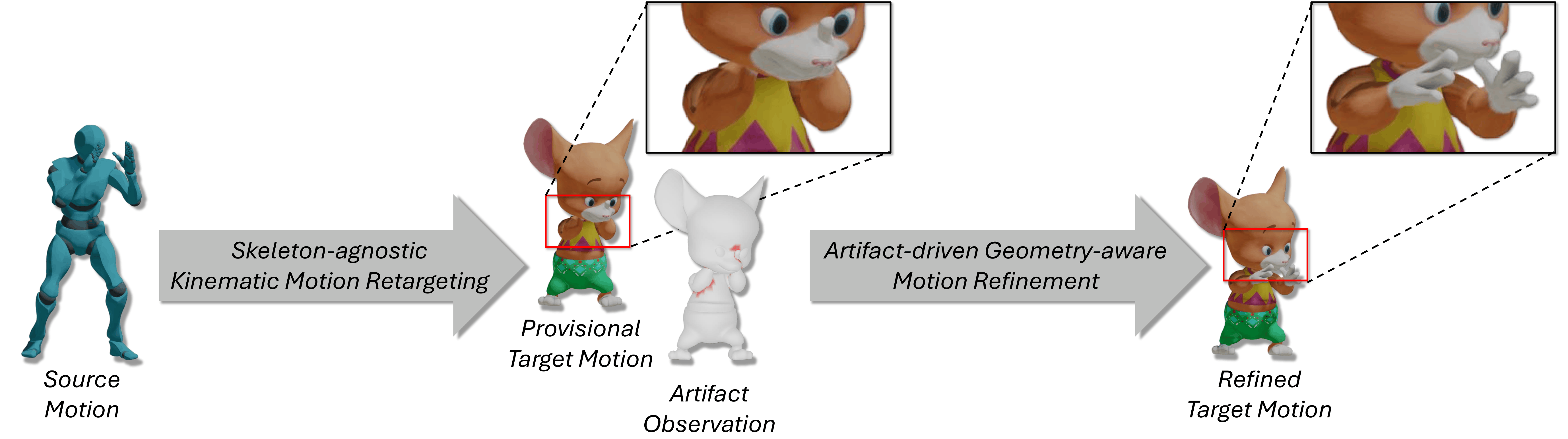
Motion retargeting aims to transfer a source motion to target characters with different skeletal structures, proportions, and body shapes.
Although recent neural retargeting methods have improved flexibility across diverse skeletons, target-side geometric artifacts such as self-penetration remain difficult to resolve.
Specifically, existing geometry-aware approaches often rely on fixed skeleton templates or implicit geometry-conditioned prediction, requiring a single network to account for target geometry deformation, detect target-side artifacts, and predict the corresponding correction from target geometry alone, which limits their ability to generalize across diverse skeleton structures and body shapes.
In this paper, we present a geometry-aware motion retargeting framework that explicitly connects artifacts observed in the posed character geometry to motion refinement while preserving the flexibility of skeleton-agnostic neural retargeting.
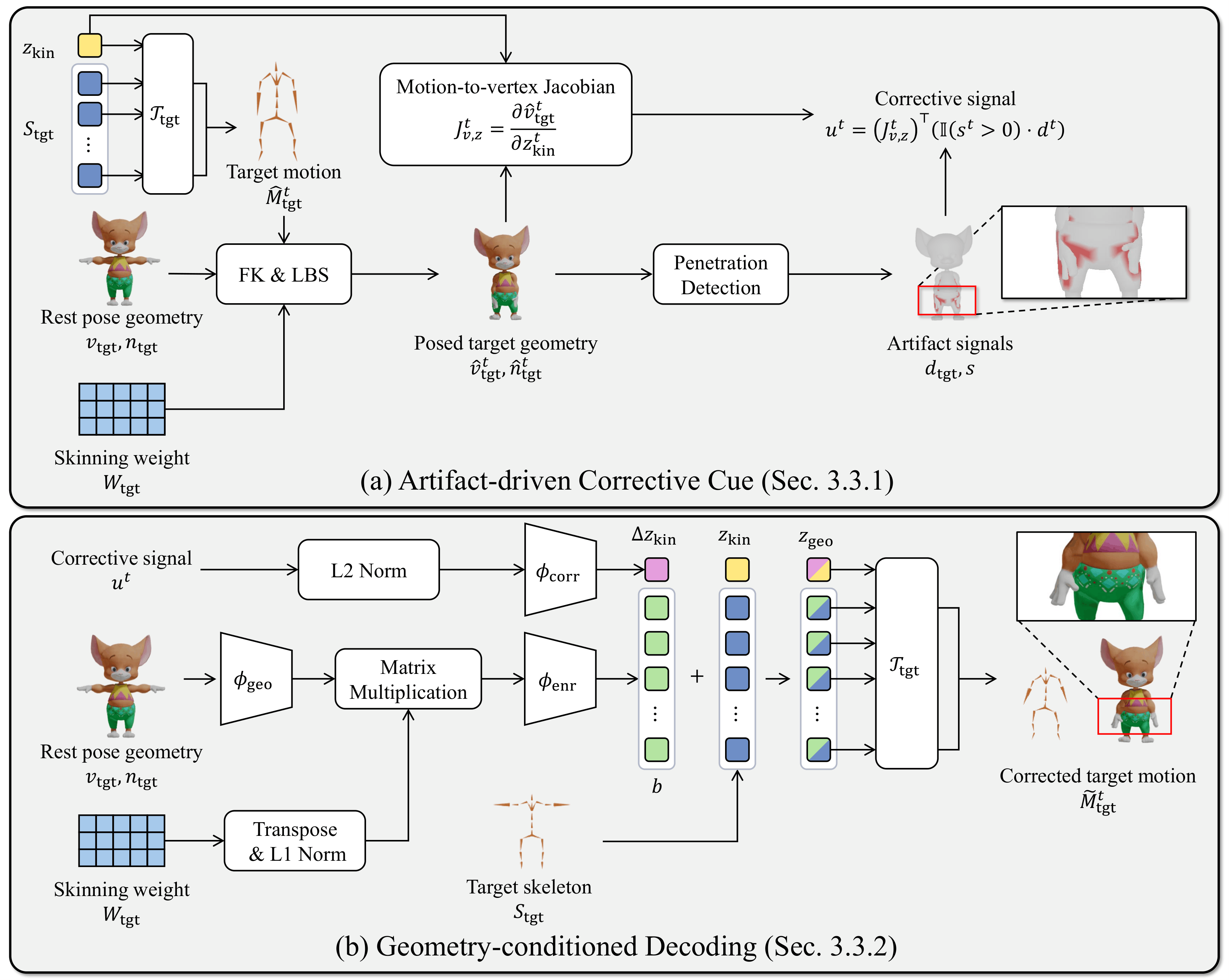
Our method first learns a motion embedding shared across different skeletons using a transformer-based retargeting autoencoder that transfers motion across arbitrary source--target skeleton pairs.
Building on this kinematic motion prior, we introduce an artifact-driven refinement module that observes self-penetration on the posed target mesh and converts it into a corrective cue through a motion-to-vertex Jacobian.
We further condition motion decoding on target geometry using skinning weight-based joint-aligned geometry features derived from the rest pose mesh.
This design combines explicit target-side artifact reasoning with flexible geometry-aware decoding in a unified framework.
Experiments on both fixed and arbitrary skeleton structure settings show that our method improves kinematic retargeting accuracy and reduces geometric artifacts, producing plausible motions across seen and unseen target characters.